
How AI Is Changing Pro Se Litigation and Expanding Access to Affordable Legal Help
More people are walking into court without a lawyer. Some do it because they cannot afford full representation. Some believe their case is simple enough to handle on their own. Others start alone because they do not know where to find help quickly.
Now AI has added a new force to that trend.
Chat-based tools can explain legal terms, summarize documents, draft letters, and help a person organize their thoughts before a hearing. For someone facing an eviction, custody dispute, debt collection case, small claims matter, or traffic issue, that can feel like a lifeline.
But AI is not a lawyer. It does not know every local rule. It may misunderstand facts, cite fake cases, or give a confident answer that is wrong. The promise is real, but so is the risk.
This article is for general information only. It is not legal advice, and it does not create an attorney-client relationship.

Why more people are representing themselves
Self-representation, often called pro se representation, has long been common in certain courts. Family law, housing, small claims, and consumer debt cases often involve parties who appear without counsel.
The reasons are not hard to understand.
Full legal representation can be expensive. Many people do not qualify for free legal aid, but still cannot afford thousands of dollars in attorney fees. Others face urgent deadlines and do not know where to turn. Some have had poor experiences with institutions and feel they must manage things themselves.
AI tools have changed the equation in a practical way. A person can now ask plain-language questions such as:
What does “motion to dismiss” mean?
How do I organize evidence for a hearing?
What questions should I ask before agreeing to a settlement?
Can you help me make this letter sound respectful and clear?
For many self-represented litigants, AI offers a first layer of understanding. That matters. Confusion is one of the biggest barriers in court. A person who understands the basic process is more likely to meet deadlines, bring the right documents, and communicate clearly.
Still, access to legal information is not the same as access to legal judgment.
What AI can do well for pro se litigants
AI works best as a preparation tool. It can help people get organized, translate complex language into plain English, and identify questions to ask a lawyer or court self-help center.
Used carefully, AI can support pro se litigants in several useful ways.
It can explain legal language in plain English
Court forms and notices often use terms that are unfamiliar to nonlawyers. AI can explain words like `service of process`, `continuance`, `default judgment`, `affidavit`, or `jurisdiction` in everyday language.
That can reduce panic. It can also help a person read a court notice more carefully before taking action.
A good prompt might be:
“Explain this legal term in plain English. Do not give legal advice. Tell me what questions I should ask a lawyer or court clerk.”
That last sentence matters. It keeps the tool focused on education rather than decision-making.
It can help organize facts and timelines
Many self-represented litigants struggle less with the truth of their story and more with how to present it. AI can help turn scattered notes into a clear timeline.
For example, a tenant might list dates of repair requests, landlord responses, photos taken, and notices received. AI can help group those facts by date and issue.
That does not prove the case. But it can make the facts easier to review, share, and explain.
It can improve drafts without deciding strategy
AI can help edit letters, declarations, and outlines for clarity. It can make a statement shorter, more respectful, and easier to follow.
This is useful when emotions are high. Court communication should be direct and calm. AI can help remove insults, repetition, and unclear wording.
The safest use is editing, not inventing. A litigant should provide the facts, then ask AI to improve structure and grammar.

Where AI can go wrong
AI tools can sound confident even when they are wrong. That is one of the greatest dangers for pro se litigants. A polished answer can create false confidence.
Courts do not excuse missed deadlines or incorrect filings just because a person relied on a chatbot.
AI may invent legal authority
Some AI systems have created fake case citations or described laws that do not exist. Even when a citation looks real, it may not support the point being made.
A pro se litigant should never file a brief, motion, or letter with case citations generated by AI unless those citations are checked through a reliable legal research source or reviewed by a lawyer.
AI may miss local rules
Law changes by state, county, court, and case type. A deadline in one court may differ from a deadline in another. Filing procedures also vary.
AI may give a general answer that sounds helpful but misses the rule that actually controls the case.
This is especially risky in:
Eviction cases
Custody and support matters
Protective orders
Debt collection lawsuits
Appeals
Immigration-related court matters
Criminal cases
When rights, housing, family relationships, immigration status, or liberty are at stake, the cost of a mistake can be serious.
AI does not know the full story
Legal advice depends on facts. Small details can change the answer.
For example, the right response to a lawsuit may depend on when papers were served, how they were served, the court named on the form, whether prior agreements exist, and what defenses are available under local law.
AI can process the facts a user provides. It cannot know what the user left out.
AI may expose private information
People often paste sensitive facts into AI tools without thinking. That may include names, addresses, Social Security numbers, employer details, medical history, financial records, or information about children.
Before using any AI tool, litigants should read the privacy terms and avoid entering sensitive personal data when possible. A safer approach is to anonymize facts.
Instead of pasting:
Full names
Exact addresses
Account numbers
Birth dates
Private medical details
Use general placeholders such as “Tenant,” “Landlord,” “Child A,” or “Creditor.”
Legal information is not legal advice
This distinction sits at the center of the AI and access-to-justice debate.
Legal information explains general rules, procedures, terms, and options. It might answer, “What is a summons?” or “What usually happens at a small claims hearing?”
Legal advice applies the law to a person’s specific facts and recommends what that person should do. It might answer, “Should I settle this case?” or “Which defense should I raise in my answer?”
AI can explain legal concepts, organize information, and even generate suggestions about a person's legal situation. However, AI-generated responses are not a substitute for advice from a qualified attorney. Legal conclusions, deadlines, and recommended actions should be independently verified before being relied upon.
Legal information | Legal advice |
Explains what a court form is used for | Chooses which form a person should file |
Defines a legal term | Applies that term to specific facts |
Describes common court procedures | Recommends a case strategy |
Lists questions to ask a lawyer | Tells a person whether to accept a settlement |
Summarizes general rights | Predicts the best legal outcome |
This boundary also matters for companies, courts, nonprofits, and lawyers building AI tools. If a tool appears to tell users exactly what to do in a legal dispute, it may create ethical and regulatory concerns.
Practical tips for pro se litigants using AI
AI can be helpful when used with care. The goal is not to let it run the case. The goal is to use it as a support tool while keeping control over facts, deadlines, and decisions.
Use AI to prepare, not to decide
Ask AI to explain, summarize, organize, and draft questions. Be cautious when asking it what you “should” do.
Better prompts include:
“Explain this notice in plain English.”
“List the deadlines I should look for in this document.”
“Help me organize these facts into a timeline.”
“What questions should I ask a lawyer about this issue?”
“Rewrite this statement so it is clearer and more respectful.”
Riskier prompts include:
“Tell me how to win my case.”
“Write a motion with case law.”
“What legal defense should I use?”
“Should I accept this settlement?”
Those questions call for legal advice. That is where a lawyer’s judgment matters.
Verify everything before filing
Before filing anything with a court, check:
The court’s official website
Local court rules
The instructions on the form
Filing deadlines
Service requirements
Any required fees or fee waiver rules
If AI mentions a statute, rule, or case, verify it with an official or reliable source. Do not assume it is real.
When possible, consult the court's official website, available self-help resources, or a licensed attorney before submitting documents. Court clerks may provide procedural information, but they generally cannot recommend legal strategies or tell a litigant how to argue a case.
Keep a human record
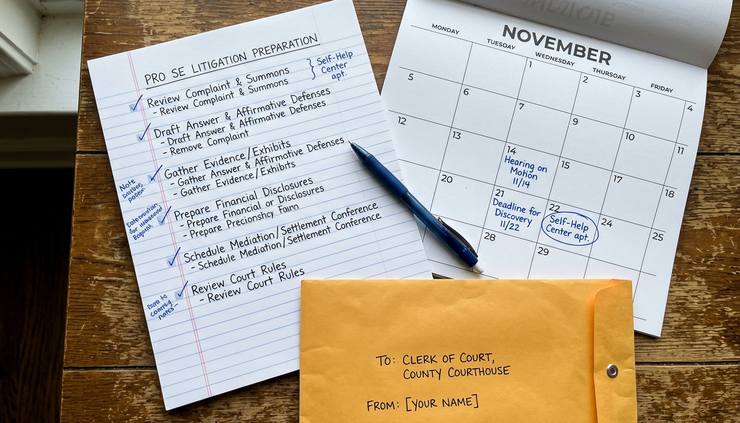
Save copies of everything filed and received. Keep a simple timeline. Track deadlines on a calendar. Bring printed copies to court if required.
AI can help create a checklist, but the litigant remains responsible for following it.
Know when to get legal help
A short consultation with a lawyer can prevent major mistakes. This is especially true when the case involves:
Loss of housing
Child custody or parenting time
Domestic violence or protective orders
Large debts or wage garnishment
Immigration consequences
Criminal exposure
Appeals or strict filing deadlines
Even if full representation is too expensive, limited help may be available.

How attorneys can make legal help more affordable
The rise of AI does not make lawyers less important. It changes where lawyers can add the most value.
Many people do not need, or cannot afford, full-service representation from start to finish. They may need help with one part of the case. That is where limited-scope legal assistance can make a real difference.
This model is sometimes called unbundled legal services. The lawyer and client agree on a specific task, while the client handles the rest.
Limited-scope representation must comply with the professional conduct rules and procedural requirements of the applicable jurisdiction. Attorneys should clearly document the scope of their engagement, explain which responsibilities remain with the client, and confirm whether limited appearances or other arrangements are permitted by the court.
Examples include:
Reviewing AI-drafted documents before filing
Explaining court notices and deadlines
Coaching a client for a hearing
Drafting or reviewing a settlement proposal
Preparing exhibits
Helping complete court forms
Giving a one-time strategy consultation
Appearing at a single hearing, where allowed
This approach can reduce cost while still giving litigants access to professional judgment.
Offer flat-fee review services
Many self-represented litigants can budget for a defined service more easily than an open-ended hourly arrangement.
A lawyer might offer flat fees for:
Document review
Answer review in a debt collection case
Hearing preparation session
Parenting plan review
Small claims coaching
Settlement agreement review
Clear scope is essential. The client should know what the lawyer will do, what the lawyer will not do, and what deadlines remain the client’s responsibility.
Build AI-aware intake questions
Attorneys will increasingly meet clients who have already used AI. Instead of dismissing that work, lawyers can ask practical questions:
What tool did you use?
What did you ask it to do?
Did it draft anything you plan to file?
Did it provide citations or legal claims?
Did you enter private information?
Have you verified the rules or deadlines?
These questions help spot problems without shaming the client.
Create safe self-help resources
Law firms, bar groups, courts, and nonprofits can publish plain-language guides that explain process, not strategy. These resources can help people understand what to expect while encouraging them to seek legal advice for case-specific decisions.
Good resources make the boundary clear. They tell users when a general explanation is enough and when legal advice is needed.
Ethical considerations for lawyers and legal technology
AI in pro se litigation raises ethical questions for everyone involved.
For litigants, the ethical duty is honesty. AI should never be used to fabricate facts, create false evidence, or mislead the court. A statement filed in court must reflect the person’s actual knowledge and belief.
For lawyers, the duties include competence, confidentiality, communication, and supervision. Attorneys who use AI must understand its limits, protect client information, and review outputs carefully. A lawyer cannot blame AI for a false citation, missed issue, or careless filing.
For technology providers, ethical design matters. Tools should avoid pretending to be lawyers. They should explain limits in plain language, encourage users to verify information, and direct people to licensed help when the issue is high risk.
Courts also face a difficult balance. They must treat self-represented litigants fairly without giving legal advice from the bench or clerk’s office. AI may help courts provide clearer information, but it cannot erase the need for human judgment and fair procedures.
AI can widen the courthouse door, but it cannot walk through that door for the person whose rights are at stake.
Access to justice means more than access to forms
AI can make legal information easier to find. That is valuable. But access to justice requires more than information.
People need language access, disability access, reliable internet, plain court forms, fair procedures, affordable legal help, and judges who can manage cases where one or both sides lack counsel.
AI may help reduce some barriers. It can translate complex text into simpler language. It can help someone prepare a timeline. It can suggest questions for a legal aid clinic. It can help attorneys serve more clients through limited-scope work.
But AI can also widen gaps if only some people know how to use it well. Those with better technology, stronger literacy skills, and more time may get more benefit. Those facing urgent crises may still struggle.
The best path pairs technology with human support. Courts, lawyers, legal aid groups, and community organizations can use AI to expand reach, while keeping legal advice, ethical duties, and accountability in human hands.
The practical path forward
AI is already changing how people prepare for court. The question is not whether self-represented litigants will use it. They will. The better question is how to make that use safer, clearer, and more connected to real legal help.
For pro se litigants, the best approach is simple: use AI to understand and organize, not to replace legal judgment. Verify rules. Protect private information. Get a lawyer’s help when the stakes are high.
For attorneys, the opportunity is just as clear. Limited-scope services can meet people where they are. A one-hour consultation, document review, or hearing prep session may be the difference between confusion and a fair chance to be heard.
AI will not solve the access-to-justice problem on its own. But when paired with ethical legal guidance and affordable service models, it can help more people move through the court system with greater confidence, better preparation, and fewer preventable mistakes.
How Kiser's Legal Support Solutions Supports Attorneys and Self-Represented Litigants
At Kiser's Legal Support Solutions (SKLSS), we understand that navigating legal proceedings requires organization, accurate documentation, and dependable professional support.
We work with attorneys, law firms, and self-represented litigants by providing court reporting, legal transcription, notary services, and administrative legal support. Our services help clients manage the documentation and logistical demands of legal proceedings.
As artificial intelligence continues to change how people prepare for legal matters, we believe technology should complement—not replace—professional expertise, reliable records, and appropriate legal guidance.
SKLSS is not a law firm and does not provide legal advice or attorney representation. Clients requiring legal advice or case-specific legal strategy should consult a licensed attorney.
Need professional legal support? Visit www.SKLSS.net to learn more about our services or request assistance.


Comments